
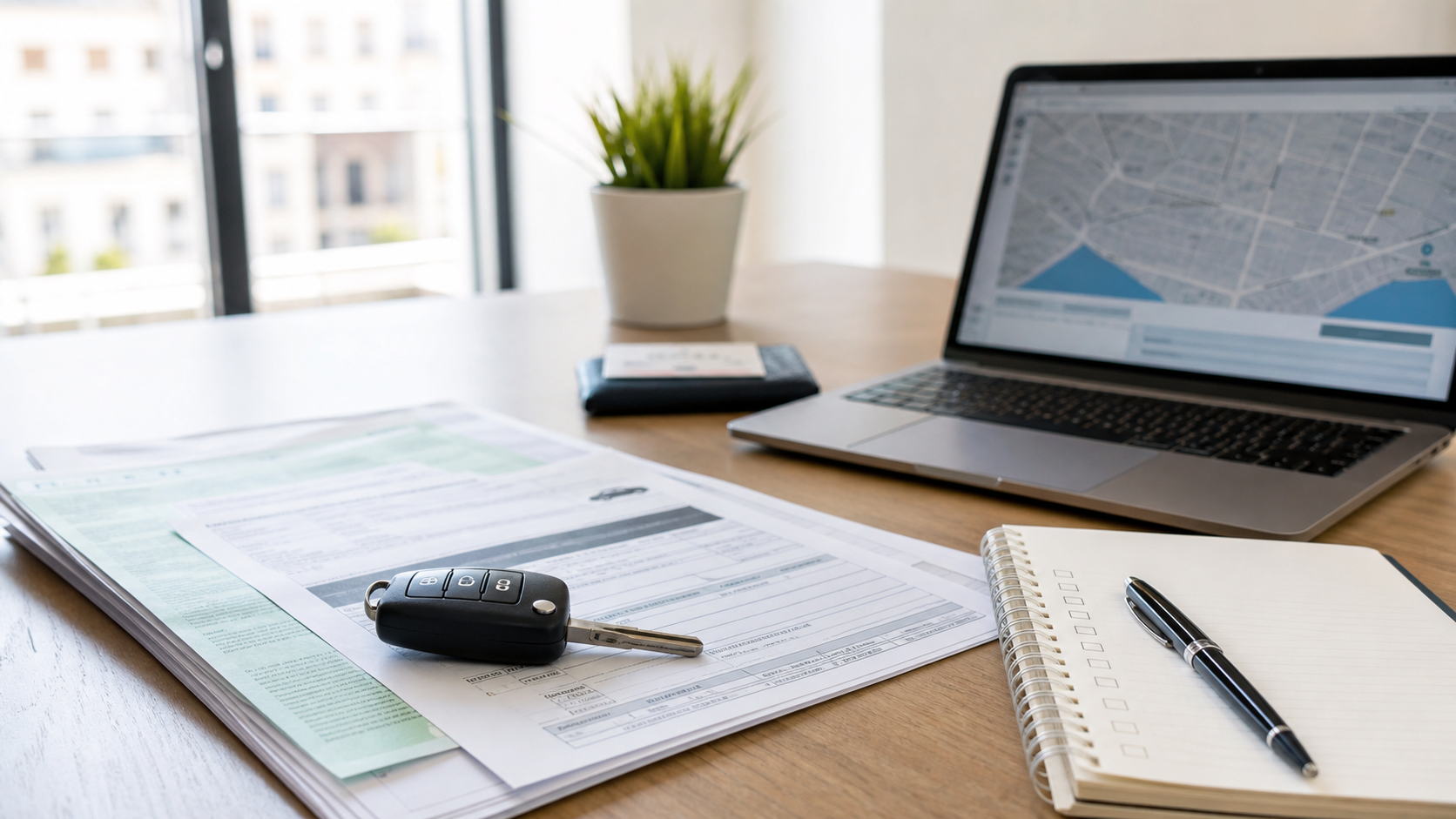
Last updated: 25 August 2026. Buying a used car in Spain can look simple until the paperwork starts. For foreigners, the risk is rarely the signature itself. The real risk is buying a vehicle that cannot be transferred easily, has charges, has an ITV problem, has unclear ownership documents or creates future fines and tax notices because the change of owner was not completed correctly.
Change of ownership, done right
We check the DGT vehicle report and file the transfer with the DGT.
70 € + VAT.
Prices exclude VAT. Spanish VAT (21 %) applies to clients resident in the EU. If you live outside the EU, our advisory services are not subject to Spanish VAT; we confirm it in your quote.
This guide explains the practical steps expats should check before buying or transferring a used car in Spain. It focuses on due diligence: the DGT vehicle report, possible cargas or administrative limitations, the difference between buying a Spanish-registered vehicle and importing one, and the points where foreign buyers often need help. It does not replace the official DGT procedure, and it does not repeat our separate foreign driving licence exchange page.
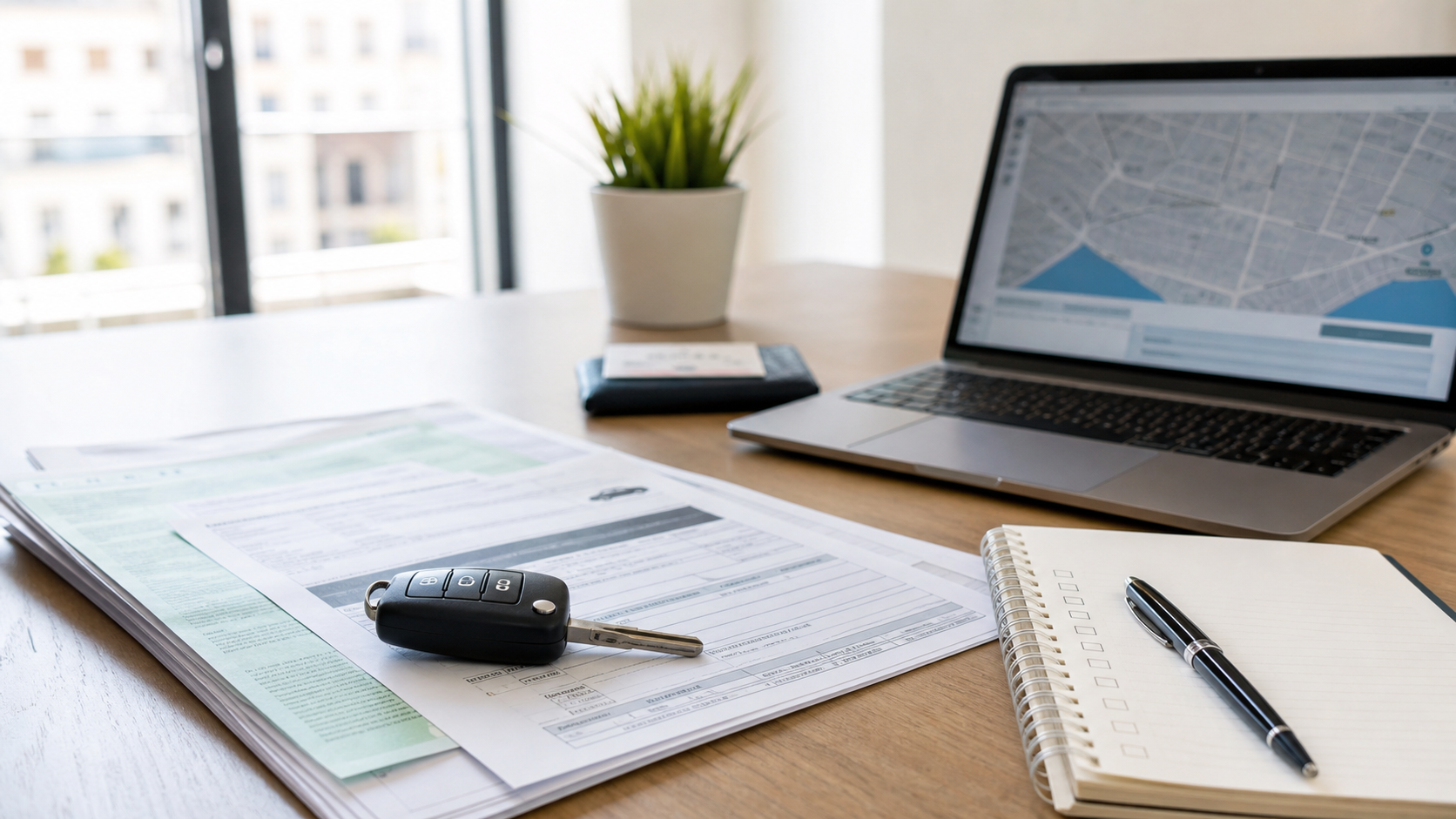
First, decide what procedure you really need
Foreigners often use the same words for different traffic procedures. “Car registration” might mean registering an imported car with Spanish plates. “Transfer” or “change of name” usually means changing the owner of a vehicle that is already registered in Spain. “Title” is a common English-language way to talk about ownership, but Spanish vehicle paperwork does not work exactly like the title systems used in some other countries.
If the car already has Spanish plates and you are buying it from a private seller or dealer in Spain, your main concern is normally the ownership transfer. If the vehicle has foreign plates, the case may be a vehicle import or Spanish registration process instead. If you plan to drive in Barcelona with a foreign-registered vehicle before it is registered in Spain, the Barcelona ZBE register may also matter. Those are separate routes, and mixing them up can waste appointments and money.
For a broader map of these routes, see our traffic procedures hub for foreigners in Spain. For imported vehicles and Spanish plates, start with vehicle registration in Spain and our guide to importing a car to Spain.
Why the DGT vehicle report matters before you buy
The DGT provides vehicle reports with public information about vehicles registered in Spain. According to the DGT, there are several types of reports, including a reduced report, a complete report, technical-data reports, charges reports, vehicles in your name, unregistered vehicles and ownership certificates. The reduced report is free and can indicate whether there is an incident that could affect transfer or circulation. More detailed reports can include administrative information, ITV history, technical data, ownership information, charges and other relevant details.
The official DGT recommendation is especially important before buying a second-hand vehicle: if the reduced report shows an incident, you should review the situation before continuing. A vehicle with an unresolved issue may be difficult or impossible to transfer until the problem is fixed. This is why the report should be checked before paying a deposit, signing final documents or relying on a seller’s verbal explanation.
Official source: DGT vehicle report information.
What are cargas and why can they block a transfer?
In vehicle paperwork, cargas are charges or limitations that may affect a vehicle. The DGT’s vehicle report information explains that a charges report can include limitations recorded in the vehicle register that may affect, for example, a change of ownership. In practical terms, this is one of the reasons a cheap used car can become expensive: the buyer may discover too late that a transfer cannot be completed cleanly.
Examples of issues to clarify before buying include administrative limitations, unpaid obligations connected to the vehicle, a temporary deregistration status, a failed or expired ITV, missing documents or a mismatch between the seller and the registered owner. Not every issue has the same consequence, so the point is not to panic. The point is to identify the issue early enough to decide whether the seller can fix it, whether the price still makes sense or whether the purchase should stop.
Documents foreigners should prepare before the transfer
The exact documents depend on the vehicle and the parties, but a foreign buyer should normally expect to clarify identity, NIE or residence documentation where applicable, the sale contract or invoice, vehicle documentation, proof of payment of relevant taxes or fees, and whether the road tax and ITV status are in order. If you are buying from a company, dealer or leasing structure, the supporting paperwork may differ from a simple private sale.
Foreign buyers should also check the address that will be associated with the vehicle and future notifications. If you recently moved to Spain, your traffic paperwork may overlap with NIE, empadronamiento or residency steps. A traffic issue can become harder to manage if official notices go to the wrong address or if the buyer cannot prove basic identity details when needed.
Seller risks: why the transfer should not be left unfinished
The seller also has a reason to care. If a car is handed over but the ownership change is not completed correctly, future fines, taxes or notices can keep appearing under the wrong person. The DGT’s second-hand vehicle guidance advises checking the vehicle and completing the relevant steps properly. For foreigners leaving Spain or selling before a move, this is especially important because fixing an unfinished transfer from abroad is much less convenient.
If you are selling a Spanish vehicle because you are moving to another country, make sure the case is really a sale and not an export or deregistration route. A Spanish vehicle that leaves Spain may require a different DGT process, such as definitive deregistration for export or temporary plates in specific circumstances. Do not use a simple private sale checklist for an export case without checking the official route.
Buying a car with foreign plates is a different case
If the vehicle has foreign plates, the question is not only “who owns it?” but whether it can be registered, imported or circulated in Spain under the conditions that apply to that vehicle. The DGT has separate guidance for bringing vehicles to Spain, and the route can depend on whether the car comes from the EU, the UK or another non-EU country. ITV, technical conformity, taxes, customs and homologation issues can become relevant.
For Barcelona specifically, a foreign plate can also trigger a ZBE question. The AMB states that foreign vehicles must be included in the Metropolitan Register before driving in the low-emission zones of the Barcelona metropolis, and that the environmental-requirements verification can take up to 15 days. That ZBE registration is not the same as transferring ownership of a Spanish-registered vehicle.
Official source: AMB foreign vehicle register for Barcelona ZBE.
A practical pre-purchase checklist
- Confirm whether the car has Spanish plates or foreign plates.
- Ask for the vehicle documentation before paying a deposit.
- Request or review the DGT vehicle report and check for incidents or charges.
- Check ITV status, mileage history where available and technical consistency.
- Confirm the seller is entitled to sell and that the identity details match the paperwork.
- Clarify municipal road tax and any pending administrative issue.
- Prepare buyer identity documents, NIE or residence details if needed.
- Do not confuse ownership transfer with import, Spanish registration or Barcelona ZBE access.
- Agree who handles the transfer and when proof of completion will be delivered.
When Barcelona Expat can help
Barcelona Expat can help foreigners understand whether a case is a used vehicle transfer, a DGT vehicle report question, a fine or notice issue, or a broader registration/import matter. The safest starting point is to explain the vehicle status, country of registration, whether you are buyer or seller, your residence situation, and any deadline already running.
If your case is about the vehicle rather than your driving licence, use the traffic services page. If your question is whether you can keep driving with a foreign permit or must exchange it, use the driving licence exchange page instead.
FAQ
Should I get a DGT report before buying a used car in Spain?
Yes. The DGT provides vehicle reports and recommends checking vehicle information before purchase, especially because incidents or charges can affect circulation or transfer.
Is buying a Spanish-registered used car the same as importing a car?
No. A Spanish-registered used car usually needs an ownership transfer. A foreign-registered car may need an import or Spanish registration route before it can be treated like a normal Spanish vehicle.
Can a foreigner buy and transfer a car in Spain?
Foreigners can buy vehicles in Spain, but the practical requirements depend on identity documents, address, vehicle status and the transfer route. Check the case before signing or paying.
If you have already decided to buy or sell and need direct support with the ownership change, use our Vehicle Transfer in Spain service form. If the vehicle is entering Spain from abroad, start with Car Import instead.